
This microphone system is used for grand piano in a live sound reinforcement setting. It provides surprisingly good sound, good isolation from other instruments, and can provide a very good "gain before feedback" for use with stage monitors. It is also less affected by a closed piano lid than almost any other method.
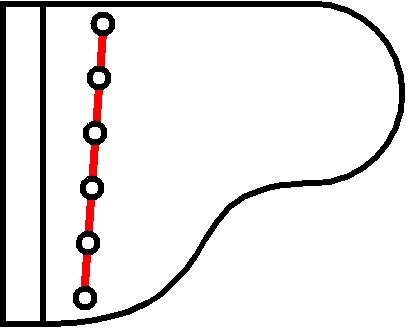
The goal of the microphone mounting is to get the capsules spaced as equally as possible across the width of the keyboard. On the treble end of the array the capsules are very close to the hammers in order to cover the shortest strings, and on the bass end the capsules are within several inches of the hammers.
Array spacing and cancellation of acoustic standing waves inside the case: With the width of the case being roughly 4 feet (from bass to treble), standing waves starting at about 250Hz are likely (especially with the lid closed). Acoustic standing waves between soundboard and lid are even more likely, but given the short distance involved these will happen at much higher frequencies. At least one commercial microphone system places capsules at 1/3 and 2/3 of the distance across the width of the body, such that even-multiple harmonics are picked up by the two capsules at opposite polarity, while the 1/3 harmonic has null points where the capsules are located. The linear array, by being evenly spaced and centered across the width of the case, provides a more effective cancellation of standing waves across the width of the case by averaging them out.
 |
 |
How does it sound? It sounds surprisingly good. Typically some sorts of phase conficts would be expected, but in practice the capsules are fairly far apart compared to how close they are to the strings, and the soundboard seems to vibrate without any major phase differences between the areas covered by the system. Each capsule picks up strings in its vicinity and a share of the soundboard. Compared to a conventional live sound method with two microphones fairly close to the strings, this system has a much more even midrange and treble. As noted, it also provides more isolation from outside sources as well. In a typical live show I would low-cut the mixer input channels at roughly 80Hz and high-cut as low as 7KHz if there are drums nearby. In a jazz big-band setting I was able to achieve usable isolation from a nearby (5 feet) drumset and the lid fully open, except during the periods of very loud drumming.
Some basic piano sounds.
Piano lid being closed while playing.
Email me. Copyright 2009 Scott Helmke